

What is Coleridge’s approach to homework?
At Coleridge, we don’t require children of any age to complete lengthy homework tasks or to produce large amounts of written work. We understand that homework can sometimes be a source of friction at home, that the evidence for its impact on outcomes for primary-aged children is inconclusive, and that home work environments vary greatly from one child to another. For these reasons, we do not believe it is advantageous — or fair — to demand large amounts of homework from young children or to create a sense of worry or failure if it is not completed.
Instead, we encourage parents to support their children with short, simple activities at home, that practise key skills. We believe this approach supports children’s learning in school by reducing the cognitive load they experience when tackling more challenging tasks with their teachers. When key skills become automatic, children can focus their thinking on new learning. For example, knowing times tables makes learning short division much easier, and being able to spell common words allows children to use more of their brain power on constructing sentences and expressing their ideas.
We also believe that setting aside short periods of regular practice at home helps to build good habits and routines around learning, and that, as children grow older, they begin to develop the skills of independence and self-organisation, which become essential when they transition to secondary school.
What exactly is expected of my child?
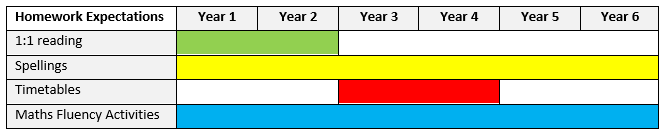
What children are expected to do at home depends on their year group. However, all homework tasks focus on practising four key areas of learning throughout their time at Coleridge.
- 1:1 reading – Each week we send home a banded reading book so that you can listen to your child read and support the development of their reading fluency.
- Spellings – A short list of high-frequency words, or words that follow common spelling patterns, is sent home each week to learn.
- Times tables practice – Each week your child will be asked to practise a particular times table to help them build recall and confidence.
- Maths fluency – Up to ten short calculation questions may be sent home each week. These help children revisit and strengthen previously learned skills.
The graphic below makes clear which of these activities apply in each year group:
Why do we focus on these skills?
Reading, spelling and number skills are the foundational building blocks for wider learning. If a child has to use all their concentration to decode words, they have less attention available to understand and think about what they are reading. In the same way, if number bonds to 10 are not secure, then adding and subtracting larger numbers becomes much slower and more difficult.
We recognise that family life is busy and that time with your children is precious. For that reason, when families are able to spend time practising at home, we believe it is most helpful to focus on high-value foundational skills that support learning across the curriculum, rather than on practising more specialised end-point tasks.
Where do I access the tasks?
If your child is in Reception, Year 1 or Year 2, then the class teacher will send home reading books each week in your child’s book bag. This will be accompanied by a reading journal, through which the teacher and parent can communicate about the child’s progress.
The spellings, times tables, and maths fluency exercises are sent to parents through Parent Hub on a Friday Evening, ready for the following week.
FAQs
How long should homework take?
Homework at Coleridge should be short and manageable. In most cases, we suggest around 10-15 minutes of practice, three to four times each week. Regular, short practice is far more effective than long sessions.
What should I do if the work is too easy?
If your child finds the homework easy, this is often a positive sign. The purpose of these activities is not to stretch or challenge in the way classroom learning does, but to rehearse key skills so that they become quick, secure and automatic. This fluency helps reduce the effort required when children tackle more complex work in school. It is important not to assume that, because the homework feels easy, your child is not being appropriately challenged in class – these tasks are designed to strengthen the foundations that underpin that more advanced learning. However, if your child is keen for additional challenge, you are very welcome to extend the activity at home by exploring more complex or varied tasks based on the same skills.
What should I do if it is too hard?
If your child finds the homework too challenging, please don’t worry. Children’s levels of effort, concentration and independence can also differ at home compared to in school, so it does not necessarily mean they are finding the same work difficult in the classroom too. We encourage you to offer guidance, talk through the questions together, and keep sessions short and positive. If your child is consistently finding the work difficult, it is important to speak to their class teacher, who can adjust the level of work, and offer further advice on how best to support at home.
How can I best support my child at home?
Helping with homework works best when it becomes a small, regular part of your child’s routine. Try to set aside a consistent time slots each week when your child is not too tired, and keep homework sessions short so they stay focused. If you have accesses to one, a table in a quiet space with minimal distractions (no TV, radio or devices) can also make it much easier for children to concentrate.
When supporting your child with maths exercise, guide them rather than give the answers. Ask questions that help them think things through and encourage them to explain what they are thinking. This helps build confidence and independence. Remember to praise effort above outcome letting children know you notice their hard work can motivate them to keep trying, even when something feels challenging.
What if we don’t manage to complete the homework every week?
We understand that family life can be busy, and there may be times when homework is not completed. This will not result in any sanctions or negative consequences in school. Our aim is to support learning, not to create pressure. If you are able to maintain a regular routine most of the time, that will have the greatest benefit for your child.
Can we do additional work at home if we would like to?
Yes, absolutely! If your child is motivated and enjoys learning at home, you are very welcome to explore additional activities. Each week, the school shares a ‘weekly overview’ outlining what your child will be learning in class. This can be a helpful guide for the types of activities you might choose to do at home. For example, if your child is learning about forces in Year 3 science, you might explore simple activities, discussions or resources online that are linked to this topic.
The teachers at Coleridge have also created additional Home Learning activity sheets linked to the learning in each year group, so please do give these a try as well. These can be found below.
Home Learning activity sheets
The teachers at Coleridge have also created these additional Home Learning activity sheets linked to the learning in each year group. Why not give them a try?
Year 1
Autumn 1
Autumn 2
Spring 1
Spring 2
Summer 1
Summer 2
Year 2
Autumn 1
Autumn 2
Spring 1
Spring 2
Summer 1
Summer 2
Year 3
Autumn 1
Autumn 2
Spring 1
Spring 2
Summer 1
Summer 2
Year 4
Autumn 1
Autumn 2
Spring 1
Spring 2
Summer 1
Summer 2
Year 5
Autumn 1
Autumn 2
Spring 1
Spring 2
Summer 1
Summer 2
Year 6
Autumn 1
Autumn 2
Spring 1
Spring 2
Summer 1
Summer 2
Additional resources and links
If you would like additional ideas for supporting learning at home, there are a number of high-quality free websites available:
- BBC Bitesize – https://www.bbc.co.uk/bitesize
Short videos, explanations and quizzes covering all primary subjects. - Oak National Academy – https://www.thenational.academy
Teacher-led video lessons and activities across the curriculum. - Oxford Owl – https://www.oxfordowl.co.uk
Free eBooks and phonics support for younger readers. - Topmarks – https://www.topmarks.co.uk
Simple, engaging maths games to build fluency (e.g. number bonds and times tables). - NRICH – https://nrich.maths.org
Problem-solving and reasoning activities to deepen mathematical thinking. - PhonicsPlay (free section) – https://www.phonicsplay.co.uk
Interactive phonics games to support early reading skills.
As with all home learning, we recommend using these resources in short, focused bursts to support key skills, rather than extended periods of screen time.